
If you’re browsing psychic readers and seeing terms like “tarot,” “clairvoyant,” and “astrologer” everywhere, you might be wondering what the practical differences are. Each approach has strengths, and understanding them helps you choose the right reading for your situation.
Here’s a simple, jargon-free explanation.
Tarot: Answers Through Cards
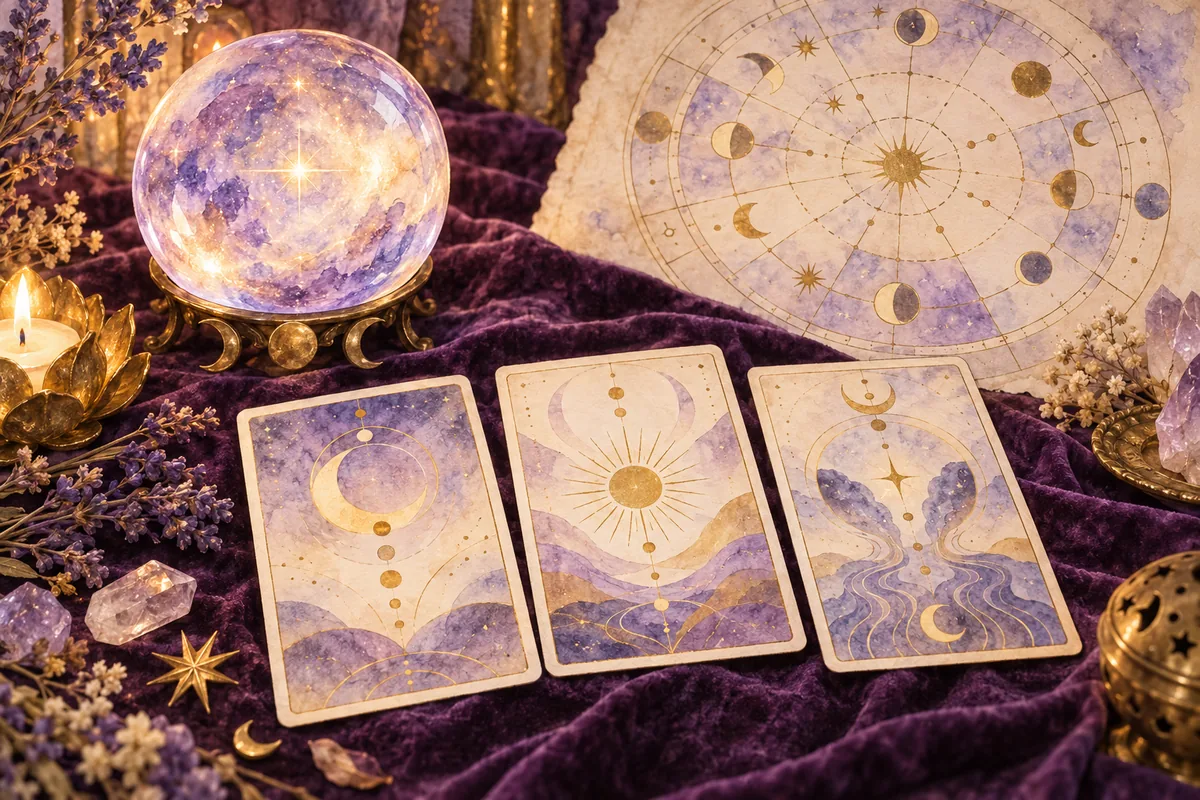
Imagine a deck of 78 cards, each one a tiny painting filled with symbolism. A tarot reader shuffles these cards while focusing on your question, then lays them out in a specific pattern called a “spread.” The combination of which cards appear, their positions, and their relationships to each other creates a story – your story.
How It Feels
A tarot reading feels structured and logical. You can see the cards, follow the reader’s interpretation, and understand the narrative being constructed. It’s visual, tangible, and often very specific.
What It’s Good For
Tarot excels at answering specific questions: “Should I take this job?” “What’s the real dynamic in my relationship?” “What should I focus on this month?” The structure of the cards forces a focused, multi-angle analysis of your situation.
What It’s Less Good For
Tarot is less suited to purely spiritual or existential questions. It’s practical by nature. If you want cosmic life-purpose guidance, another modality might serve you better.
Clairvoyance: Answers Through Vision
A clairvoyant doesn’t use any tools. They close their eyes (sometimes literally), tune into your energy, and receive information through intuitive vision – images, symbols, scenes, feelings, and impressions that arise spontaneously in their mind.
How It Feels
A clairvoyant reading feels more fluid and unpredictable than tarot. You might ask about your career and the reader starts talking about your mother. This isn’t randomness – it’s the reader following the energy to whatever is most relevant, which may not be what you expected.
What It’s Good For
Clairvoyance excels at revealing what you don’t know you need to know. It’s brilliant for open-ended guidance, uncovering hidden dynamics, and receiving information you hadn’t thought to ask about. The spontaneous nature of clairvoyant perception often produces the most surprising and impactful readings.
What It’s Less Good For
If you want a very structured, step-by-step analysis of a specific decision, clairvoyance may feel too free-form. It follows energy rather than structure, which means the reading goes where it needs to go, not necessarily where you planned.
Astrology: Answers Through the Stars
An astrologer uses the positions of planets and stars at the exact time and place of your birth to create a “birth chart” – essentially a cosmic snapshot of the sky at the moment you arrived. This chart reveals personality traits, life themes, relationship patterns, and timing cycles.
How It Feels
An astrology reading feels systematic and precise. The astrologer references specific planets, houses, and transits – technical terms that they’ll explain as they go. There’s a mathematical precision to astrology that some people find deeply satisfying.
What It’s Good For
Astrology is unmatched for timing questions. “When is the best time to start my business?” “What kind of year is 2026 going to be for me?” “Why does this keep happening every few years?” Astrology identifies cycles and patterns with a specificity that other modalities can’t match.
What It’s Less Good For
Astrology requires your birth details (date, time, place), which not everyone has. Without an accurate birth time, some aspects of the chart become unreliable. It’s also less spontaneous than clairvoyance – the reading is anchored to your chart rather than flowing freely.
Quick Comparison
| Tarot | Clairvoyance | Astrology | |
|---|---|---|---|
| Uses tools? | Yes – cards | No – pure intuition | Yes – birth chart |
| Structure level | Medium | Low | High |
| Best for | Specific decisions | Hidden insights | Timing and cycles |
| Surprise factor | Medium | High | Low |
| Requires info? | Just your question | Just your question | Birth date/time/place |
Can They Be Combined?
Absolutely. Many of our readers are skilled in multiple modalities. A reading might start with astrology to understand the timing, shift to tarot for a specific decision, and close with clairvoyant impressions about the spiritual dimension. Combined readings are often the richest and most complete.
Which Should You Choose?
- I have a specific question about a decision → Tarot
- I want open-ended guidance and surprise insights → Clairvoyance
- I want to understand timing, cycles, and patterns → Astrology
- I’m not sure what I need → Start with clairvoyance (most flexible) or use our matching system
There’s no wrong choice. Each modality offers genuine value, and the best reading is the one that matches both your question and your personality.
What a Session Looks Like in Each Style
It helps to picture the practical shape of a session. In a tarot reading, you will usually be asked for your question and may be invited to choose a spread, such as a three-card line for past, present and next steps. The reader turns the cards, explains what they see and checks the interpretation against your situation. A clairvoyant session is more conversational: the reader may begin with impressions, ask whether they make sense and follow whichever thread feels strongest. An astrology session often starts with your birth details, then moves through the main themes of your chart and the planetary movements relevant to your question.
Questions That Fit Each Method
- Tarot: “What should I weigh up before I accept this offer?” or “What is helping and hindering my plans right now?”
- Clairvoyance: “I feel stuck and cannot say why. What am I missing?”
- Astrology: “Which parts of this year are better for starting something new?” or “Why do I keep seeing the same pattern in my relationships?”
Phrase questions as open ones where you can. “What do I need to understand about this situation?” tends to produce more useful answers than “Will this work out?” and keeps the decision in your hands.
A Note on Evidence and Expectations
These practices are traditions of interpretation. They are not scientifically validated ways of forecasting events, and no reader can know the future with certainty. Many people use them as structured prompts for reflection, a way to slow down and look at a situation from another angle. Go in with curiosity rather than demands, and weigh anything you hear against your own judgement and the advice of professionals where health, legal or financial matters are involved.
Trying a Second Method
You do not have to pick one method for good. Some people begin with tarot to clarify a decision, then book an astrology session for timing, or follow an intuitive reading with tarot for structure. Treat each session as a separate conversation and give yourself time between them. When you are ready to compare readers, the specialty directory and the guide on choosing the right psychic reader will help you narrow the list.
Ready to explore? Browse readers by specialty to find the right modality for your question. Learn more about how our platform works.